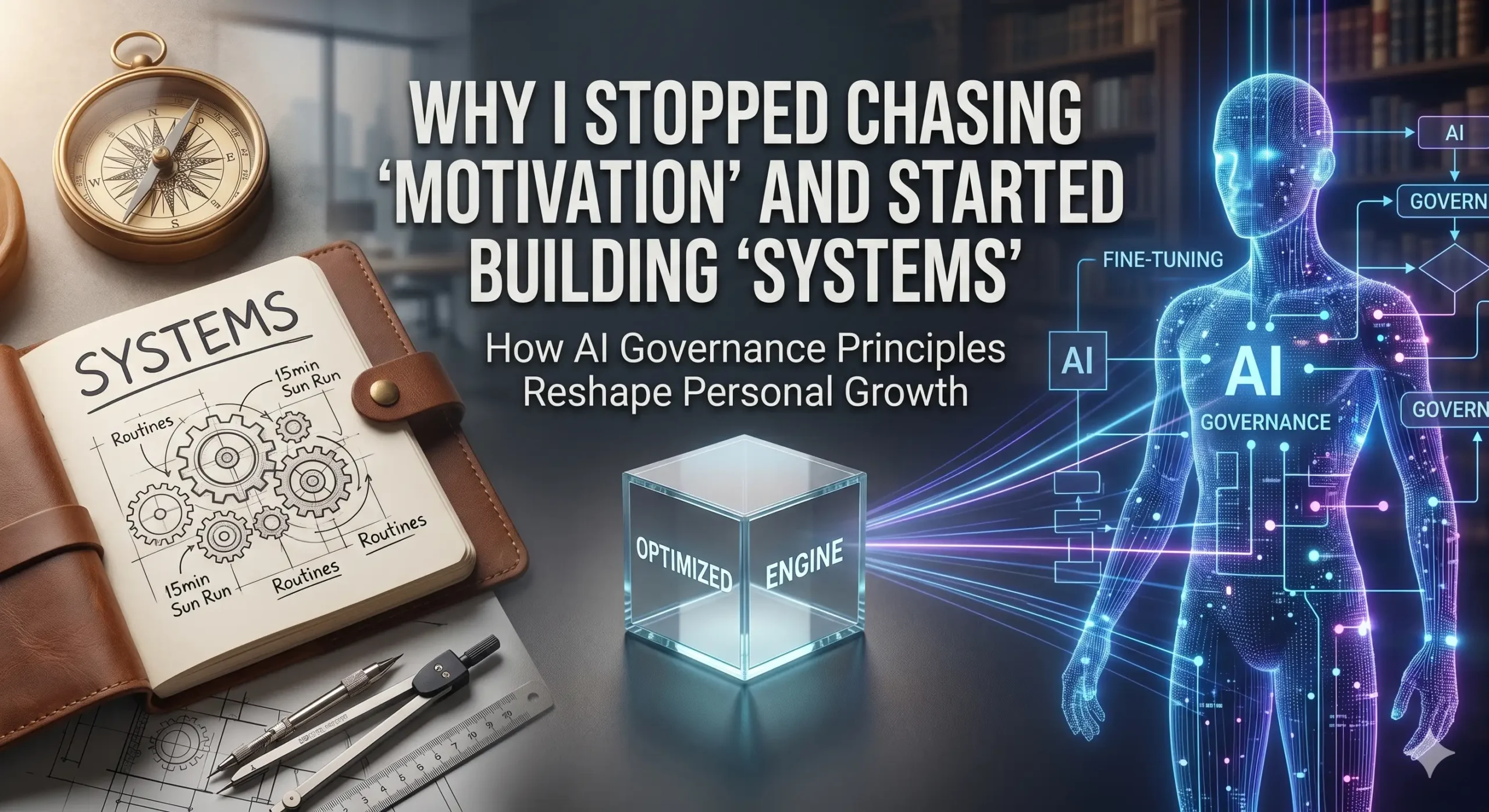
최근 AI를 나름 깊게 파고들며 흥미로운 지점을 발견했습니다.
AI가 데이터를 처리하고 최적의 결과를 도출하는 ‘알고리즘’의 과정이, 우리가 삶을 경영하고 목표를 달성하는 ‘자기관리’의 메커니즘과 본질적으로 닮아 있다는 사실입니다.
17년 차 법률 전문가의 시선으로 분석한 ‘AI와 인간 성장의 공통점’, 그리고 우리가 이 기술로부터 배워야 할 ‘전략적 규율’에 대한 단상을 영문 칼럼으로 정리해 보았습니다.
AI 시대에 나만의 엔진을 어떻게 최적화할지 고민하는 분들에게 작은 영감이 되길 바랍니다
Why I stopped chasing “Motivation” and started building “Systems”
James Clear’s Atomic Habits notes: “You do not rise to the level of your goals. You fall to the level of your systems.”
Throughout my life, and especially over my 17 years as a Corporate Lawyer, I’ve realized this isn’t just a productivity tip—it’s a fundamental truth. Whether it’s for our personal lives, our organizations, or even AI, motivation is just a spark. Systems are the engine.
Take my morning routine: For nearly a year, I’ve been doing a 15-minute “Sun Run” every single morning. Because it’s a built-in system, it requires zero willpower. I don’t “try” to run; I just do it.
Currently, I am navigating two paths to redefine my career: technical training at the Microsoft AI School and independently pursuing the IAPP AIGP (AI Governance Professional) certification. These journeys have led to an “Aha moment”:
I found that the way we build trust in AI is similar to how we should design our own lives—through Governance.
1. Habits are like “Fine-tuning”
Relying on motivation is like giving an AI a random prompt and hoping for a masterpiece. It’s hit-or-miss. Real success comes from fine-tuning our daily routines. Once the system is set, you preserve your mental energy for what truly matters: high-level judgment and complex problem-solving.
2. A Personal Framework: Aligning with “GOVERN”
I used to find my energy depleted by a constant stream of unnecessary thoughts – much like an unoptimized AI system wasting computational power on background noise.
I realized my strategic framework for moving from mental exhaustion to clarity mirrors the NIST AI RMF logic:
GOVERN: I set a firm principle: “Health-centricity.” Just as AI must be human-centric, my personal governance priorities well-being.
MAP: I identified where my focus was leaking. Those “idle thoughts” were consuming significant mental resources without adding any value.
MEASURE: I moved from vague feelings to objective observation. By practicing daily meditation and tracking my sleep and energy data with a wearable device, I assessed my personal recovery patterns.
MANAGE: I built “guardrails” to prevent burnout. Deciding what NOT to focus on became my most effective oversight mechanism.
While I am still on a journey toward optimal health, this system has led to a significant improvement in my own personal baseline for sleep quality and daily condition.
3. Making Progress Inevitable
In the professional world, we can’t always control the final outcome, but we can control the process.
Predictable Excellence: A good system makes excellence a consistent result, not a one-time lucky break.
Reliability over Ambition: I am working hard every day to refine my own systems, ensuring that my growth—however gradual—stays aligned with my core values.
Growth isn’t about being “perfect.” I believe it’s about building a governance system that makes becoming a better version of yourself inevitable.